Posts

Eurocrypt 2023 and Lattices Meet Hashes Workshop: Benjamin Bencina
Image
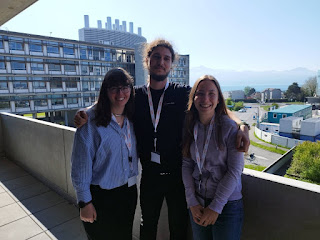
For a lot of us CDT researchers, the past month and a half has been a period of travel and conferences. Soon after we returned from Japan, where we visited the wonderful Real World Crypto (s ee this blog post for more details of the trip), another conference was around the corner. At the end of April, a few of us had the pleasure of attending Eurocrypt 2023 , one of the three main general conferences organised by the IACR, this year organised in Lyon, France. Moreover, the conference was followed by a workshop on post-quantum zero-knowledge proofs in Lausanne, Switzerland, a mere three hour train ride away on the shores of Lake Geneva, which made this trip even more worthwhile, as it almost felt like there was a 2-for-1 sale on cryptography events in Europe.  Eurocrypt was scheduled over five days, from Sunday, April 23, to Thursday, April 27. Once I arrived to Lyon on Sunday afternoon and settled into my accommodation, I headed over to InterContinental Lyon, a short walk away fr...
Nebuchadnezzar: Entering (and Exiting) the Matrix: A retrospective on my first year and a half of research: Dan Jones

Image
I am still working on the ‘Summer’ project I started at the end of my training year. Whilst I believe this is a common occurrence in the CDT, it can still be an occasional source of anxiety! Before I explain what’s taken me so long, I’ll quickly explain the project. I worked with my now supervisor, Martin Albrecht, to study Matrix, a protocol for end-to-end encrypted group messaging (think WhatsApp group chats). The protocol has over 80 million users, and is well used among the open source and free software communities as well as several governmental organisations. They have a presence in government organisations within France, Germany and Sweden. This includes healthcare services and, in the case of Germany, their military. Our initial goal was to analyse the protocol. We would study it, precisely define its intended security goals, then determine whether it fulfils those goals. It’s in the final step that we attempt to write a security proof. This would be the first time I would...

Real World Crypto Review: Mikaela Brough & Wrenna Robson

Image
 From March 27-29, some of the CDT’s researchers had the opportunity to attend Real World Crypto (RWC) 2023 . RWC moves venue every year, last year being in Amsterdam and next year in Toronto. This year, it was in Tokyo. RWC is focused on bringing together cryptography researchers from academia with developers who implement cryptography in their systems, thus creating open and interesting dialogue between these two communities. Notably, RWC does not publish proceedings from presentations, and talks are solely selected based on how much interest they would be to the intended audience. The talk selection process is not intended to evaluate the academic quality of a piece of research, but rather the potential impact that it would have on society or technology. Therefore, the collection of contributed and invited talks were particularly engaging, with the findings of the different studies having immense current and future impact in the real world. Many of us in the CDT had an interest ...

CDT in Cyber Security for the Everyday Showcase-April 20th 2023: Professor Keith Martin

Image
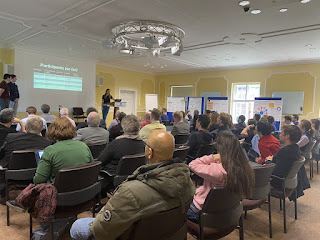
 The EPSRC Centre for Doctoral Training (CDT) in Cyber Security for the Everyday was delighted to host the return of our annual Showcase as an in-person event at Cumberland Lodge in Great Windsor Park. The CDT funds around ten PhD research studentships each year, with each cohort of researchers undertaking an immersive year of training in cyber security, followed by three years of research. The Showcase welcomed members of the CDT, colleagues at Royal Holloway, and external partners, to learn about some of the fascinating work being undertaken by researchers across the CDT cohorts, and across the many disciplines that relate to cyber security. The opening session featured presentations by several students who have already commenced their studies. Nicola Bates discussed her use of `systems thinking’ to improve the accessibility of knowledge in the cyber domain for key organisational decision makers. Giuseppe Raffa then presented his work on evaluating the effectiveness (sometimes in...

Digital Security in Latin America - Early Perspectives on Establishing a Research Group: James Barr

Image
  “Some other countries are struggling, such as Mexico. They need to tackle crime, not cyber security. ” “The price of Chinese technology is much more accessible compared to European or American companies. Paraguay does not produce any technology.” “In Latin America we can confuse some platforms with the internet itself. The experience of going online is through social media apps, this is a challenge.’’ “Latin America is the most peaceful region regarding interstate conflict and most violent in interpersonal conflict and/or violence. We have to shift focus more towards everyday violence and the use of technology to oppress people.’’ These quotes, captured in a workshop held by the Digital Security in Latin America Research Group (DLSA) in December 2022, illustrate a very important (if sometimes overlooked) point: the importance of context. By context we refer essentially to how the digital relates to, shapes, and is shaped by the on-the-ground realities emergent in a specific...

Cyber 9/12 Experience: Tash Buckley

In February I had the honour and the pleasure of being invited to coach the fantastic team Krack-In Security for this year’s  Cyber9/12 competition , a mixed university team made up of four students from Durham, Edinburgh and St Andrews.  I entered Cyber 9/12 as a competitor for Royal Holloway in 2020, coming in as finalists, and I got so much value from the experience that the next year I volunteered to be part of the organising team. It was brilliant to experience the competition this year in person again for the first time since 2020, and from a different perspective. In the lead up to the competition students receive an intelligence brief containing a range of artefacts from news reports through to government communications. Their job is to digest and analyse the information to try and get a handle on what is actually going on. My role as the coach was to help develop their ideas and theories, and help to rein in some of the more out-of-the-box suggestions. With lots of ha...

Exploring the Future of Transport in Australia: Challenges and Opportunities in a Vast Land: Oliver Bock-Brown

Image
 Australia is a large country. It’s one thing to know this, another to experience it. To reach the southeast of the country—where you’ll find Melbourne and Sydney—you first have to fly across almost the entire expanse of the country. This part of the flight alone is well over four hours, which is slightly longer than it would take to fly from the UK to Turkey. That, of course, is only a small part of the overall journey, which comes in at something like twenty-two hours of flying. I recently got to experience this journey when I had the chance to visit Australia. And with an interest in future impacts of autonomous mobility systems—and after recovering from the jetlag—I used the trip both to explore the unique Australian context of transport systems, and to speak to a range of people about the subject. The sixth largest country in the world, Australia has a land area of nearly 7.7 million square kilometres. That’s broadly similar in size to the United States, but with a population ...

IEEE BigData 2022 Report: Giuseppe Raffa

Image
 Considering the growing importance of the topic of big data, it comes with no surprise that the IEEE conference dedicated to it is now a well-known and well-attended event, which attracts academics as well as industry practitioners. Last December, I was lucky enough to attend IEEE BigData 2022 in Osaka, Japan, where I presented the paper “Evaluating Anti-Virus Effectiveness in Linux” – joint work with Daniele Sgandurra and Daniel O'Keeffe – at the The 6th International Workshop on Big Data Analytic for Cyber Crime Investigation and Prevention . It is not hard to imagine that the preparation of the trip has taken a bit of time. While initially it appeared to be a daunting task – probably the psychological effect of the pandemic – I managed to complete all the necessary bureaucratic steps fairly quickly. I was, in particular, relieved to know that Japan had relaxed the COVID-related entry requirements in mid-October, and also reinstated VISA-free travel for numerous countries. Even ...

MAKING A DIFFERENCE IN CYBERSECURITY AS A CDT STUDENT: Stephanie Itimi

Image
Promoting diversity in cybersecurity is crucial for the success and innovation of the field, and I am grateful to be part of a university community that recognises and values the importance of diversity. Their support has allowed me to not only learn and grow as a student, but also to contribute to creating a more inclusive and representative cybersecurity industry. Through my foundation Seidea CIC , a career development platform aimed at diversifying the cybersecurity field, I have been able to support over 5,000 Black and Minority Ethnic women and girls worldwide as they enter the industry through career development programs and community engagement. Our partnerships with industry leaders such as KPMG, Sage, Plexal, and Accenture have allowed us to shape the talent pipeline, implement diversity and inclusion initiatives, and create internship opportunities within companies. My work with Seidea has earned me recognition as a 2022 Cyber Security Influencer by the Evening Standard, as ...

Black Hat Europe 2022 Report: Benjamin Bencina

Image
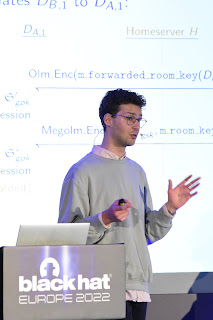
Below we hear from first-year CDT students Benjamin Bencina and Shubham Pawar who attended Black Hat  which was held in London in early December.  At the beginning of December, Shubham Pawar and I had the pleasure of attending Black Hat Europe, the European (including the UK) rendition of the internationally recognised cyber security event Black Hat. The event was hosted in London this year, and I’ve been following the research presented at Black Hat for a few years now, so there was no excuse not to attend. Luckily, our advisor Martin helped us get free student passes, since we were not there to present our own work, but mainly to indulge our curiosities. The briefings were scheduled over two days, each day beginning with a keynote and ending with a locknote, where various Black Hat veterans and cyber security practitioners tried to capture and discuss the current state of cyber security, and pave the way forward. While we were mostly interested in the briefings themselves, i...

Norway Trip: Erin Hales

Image
At the end of October, I went to Bergen for a week-long research visit to Simula UiB. I was visiting two collaborators to work on a research project which came out of discussions at the Edinburgh summer school that I organised together with Joe and Rachel this summer. It was great to visit Norway again, after being in Trondheim earlier this year for Eurocrypt. This time, however, it was much colder, and quite a bit darker too! It's great to be able to travel again and visit other researchers, especially those at a similar stage of research to me. Having collaborators and friends around the world is like a bigger version of the cohorts we have in the CDT. We discussed our research ideas, and broke several of them. It's much easier to argue about how the secret keys are distributed when you're in the same room with a whiteboard in it, as well as plentiful cups of tea! As well as getting lots of work done, I was able to participate in the Norge Kryptoseminar, or the Norwegian ...

Friendships – the hidden key to doing a PhD: Laura Shipp

Image
Nearly two weeks ago, I handed in my PhD after five years within the CDT. The experience has been so varied both in activities and the things that life has thrown at me since I began. Overall, it has been a good experience with some difficult points, but I feel so relieved to and proud to have got here. The day before I handed in I had to work on writing my acknowledgements. In my head, this signified that the journey was coming to an end and allowed me to reflect along the whole process. Writing those acknowledgements made me realise how much I have needed my friendships in order to get to the finish line. It made it clear how much I have relied on this form of support along this journey and how thankful I was for this. PhDs can often passion projects. Many people pour their time, effort, frustrations, tears, and a lot else into their thesis. This was very much the case for me and at times, I felt like the thesis could swallow me whole. At other points it was frustrating or draining. ...

Reflections on our first year in the CDT: Students from the 2021 Cohort

S tudents from our 2021 cohort recently enjoyed their viva session in which they had the opportunity to present their summer project and officially mark the end of the taught component of their course and embark on the research phase. This viva session is always a highlight for us and this year was no exception. The variety of talks was inspiring and there were some superb presentations, with speakers delivering their talks in a calm, measured style!  Below, we hear from some of the 2021 cohort who have written a short article about their first year experience and the move to the research phase of their PhD: Cherry Jackson Introduction Having now completed the first year of a PhD through Royal Holloway's CDT, it is hard to fathom how most PhD students just simply throw themselves into the choppy waters of academia. The first year provided a flotation device. Without the opportunity to dip a toe into the programme, gather my bearings and try out different routes, I suspect I ...